Human factor is usually blamed on people. In practice, it is often designed into the information system they are expected to use.
Human factor is not a discipline problem
Most operators follow their instructions. Technologists understand their processes and engineers care about quality. The recurring difficulty lies elsewhere: limited time, delayed information, cognitive overload and the need to interpret several noisy or contradictory indicators.
When a person must make dozens of small classifications during a shift, variability becomes inevitable even with excellent training. Human factor is not a moral failure. It is a systems problem.
Decision latency is the real enemy
Production decisions are often made too late because the signal appears late, remains weak or is buried in unrelated information. By the time the deviation becomes obvious, the process has already drifted. Even the correct response is now reactive.
Reducing human factor means shortening the distance between reality and understanding. The role of automation is to suppress irrelevant variation, highlight early indicators and present evidence in a form that requires less interpretation.
Why generic OEE platforms become expensive
Packaged OEE systems offer broad function lists because they must fit many factories. A specific operation may use only a small part of that package while still carrying its licensing, configuration and maintenance burden.
The deeper problem is not unused screens. Generic definitions frequently fail to match the way work actually moves. Planned time, changeovers, microstops, blocked time, starved time, quality holds, laboratory release and rework may all have different meanings for one process.
If the software cannot represent those distinctions, people create spreadsheets and manual corrections around it. The dashboard remains visually complete while trust moves elsewhere.
Fit the metric to the decision
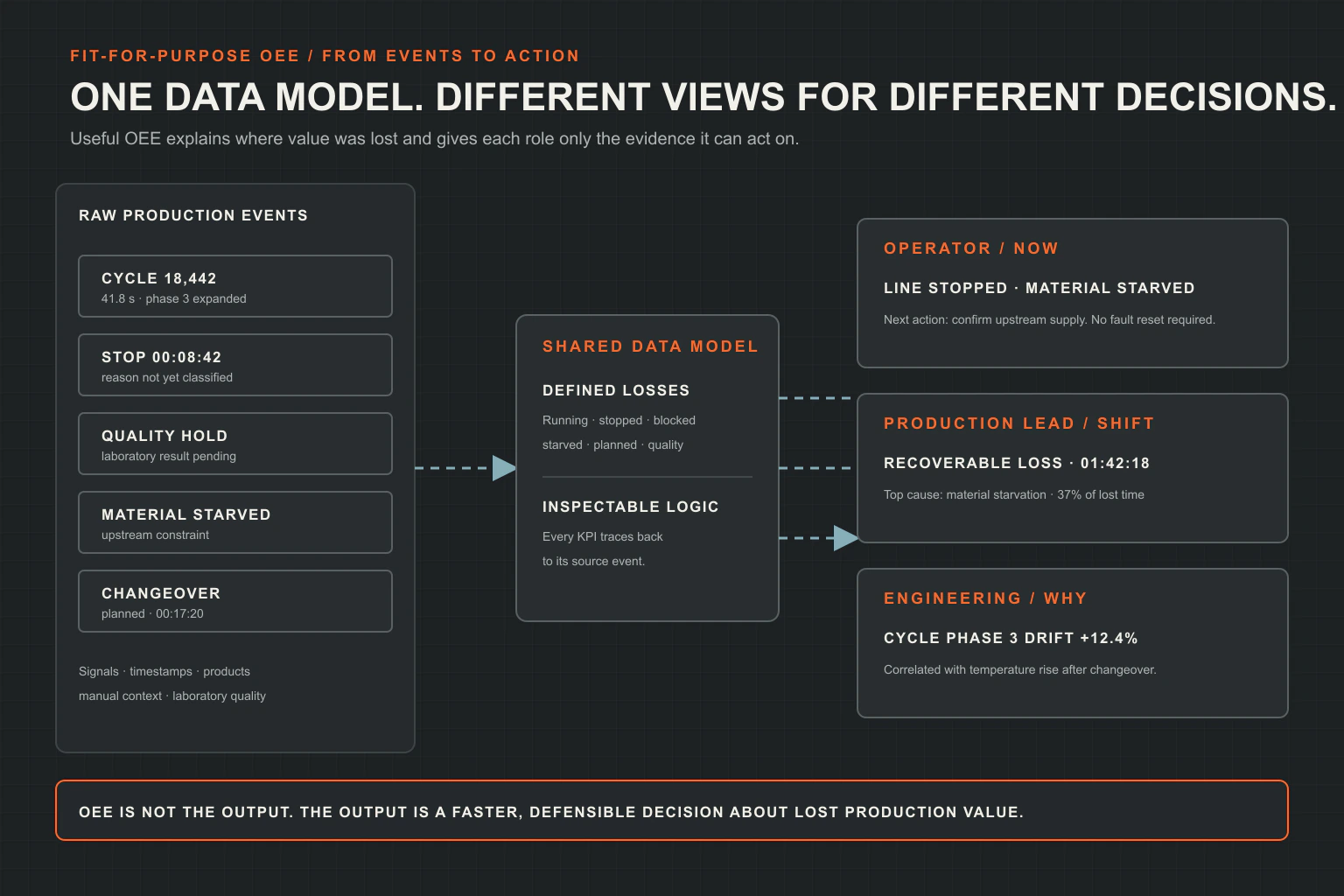
Fit-for-purpose OEE begins by defining which losses the organisation can act on. Availability should distinguish a machine failure from a material shortage or an upstream constraint. Performance should use a defensible ideal cycle and expose where cycle phases expand. Quality should reflect when a result becomes known and whether rework returns value to the process.
The same principle applies to reports. An operator needs current state and the next action. A production lead needs shift loss and unresolved incidents. Engineering needs event timelines, signal trends and product context. Management needs stable definitions and the ability to trace a headline KPI back to evidence.
Fewer decisions, better decisions
If an operator must decide whether something is wrong, how serious it is and what caused it, variability is unavoidable. If the system answers the first question and structures evidence for the second, human experience can focus on the third.
Automation should not tell people what to think. It should tell them where to look. Exception handling is a better use of human judgement than continuous surveillance and manual classification.
Build only what the operation will own
A smaller system is not automatically simpler, but it can be deliberately bounded. Use the signals required by the workflow. Define events transparently. Keep calculations inspectable. Make manual corrections visible rather than hiding them. Provide the reports people actually use and document how every KPI is produced.
This reduces licensing waste and makes future modification a normal engineering task instead of a vendor change request. More importantly, it creates a shared operational language.
Good OEE is not a decorative percentage. It is a compact explanation of where production value was lost, supported by evidence detailed enough for someone to act.