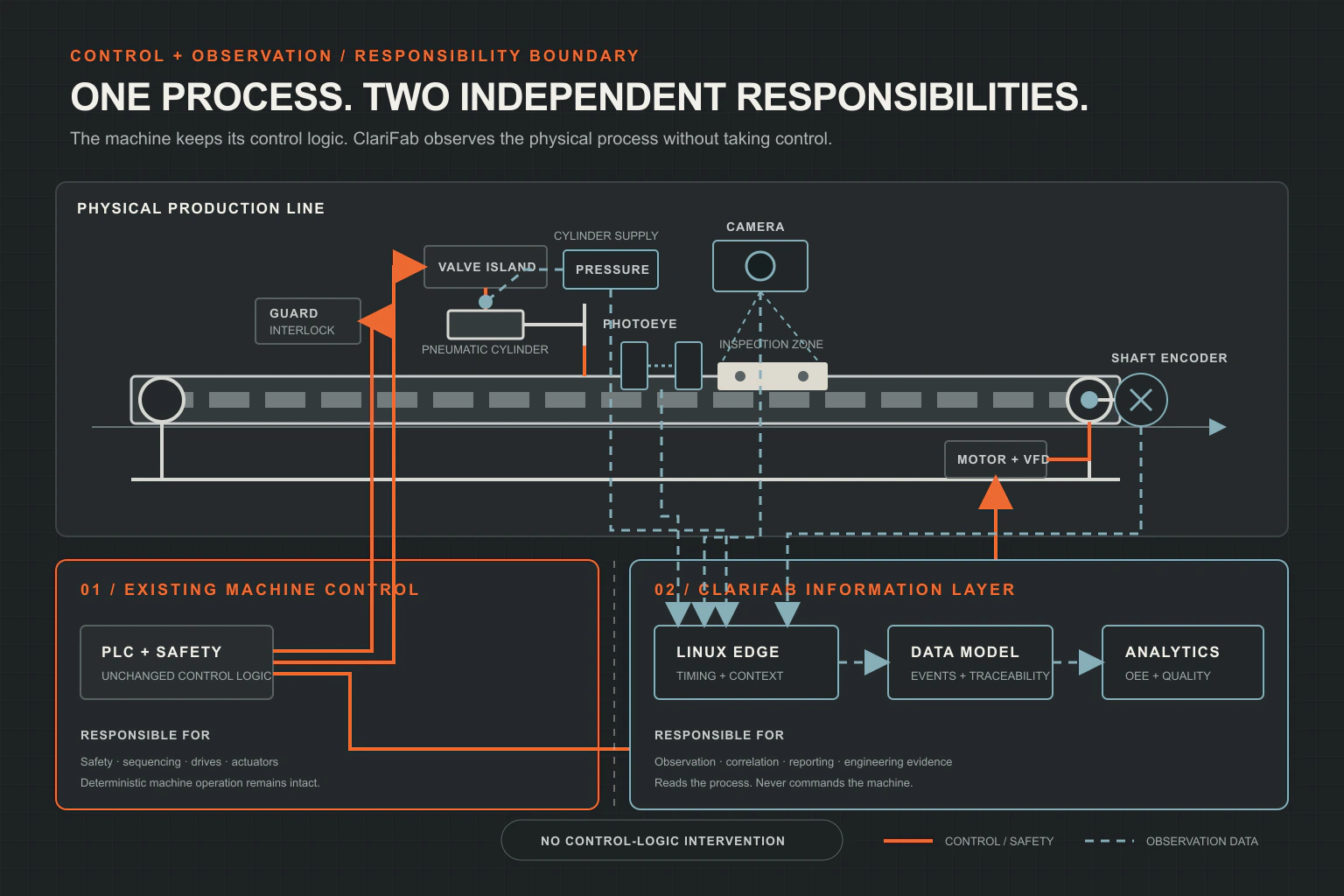
The PLC is the correct place to control a machine. That does not make it the correct place to experiment, interpret ambiguity or build every new information function.
Why automation usually starts in the PLC
The PLC controls the process, so it feels natural to place every improvement there. In a real factory, however, the PLC is more than a technical device. It belongs to a protected operational ecosystem.
Control networks may be isolated or segmented. Access is governed by formal rights. A small logic change can require the machine builder, system integrator, IT, security, documentation, validation and a planned production stop.
These controls are necessary for safety and reliability. But they also mean that a useful idea can become organisationally disproportionate to the problem it solves.
The PLC is not the right place to think
PLCs are excellent at executing predefined logic, reacting predictably to signals and keeping the process inside a validated operating envelope. They are not designed for ambiguity, probabilistic interpretation, image analysis or rapid experimentation.
Forcing those tasks into the control program can create brittle logic and long validation cycles. A “small improvement” becomes a controls project, and the controls project is postponed because the production risk is greater than the expected benefit.
Start where reality meets the system
The edge is the physical boundary around the line: sensors, cameras, encoders and carefully isolated signals. An edge device can timestamp observations, create production events, run vision models and forward structured data without entering the control network.
The base machine continues to control motion and safety. The new layer observes what physically happened. It can be tested, modified or removed without pretending that it owns the production sequence.
This independence matters especially for used or mixed-generation equipment. One factory can contain several PLC families, proprietary controllers and machines whose original builder no longer provides support. The information layer does not require all of them to become uniform before it can build a coherent production picture.
A black box with a clear contract
A useful edge system is loosely coupled and explicit about its boundary. It watches, analyses and reports. Where an output is required, the interface can be simple: part accepted, part rejected, trend detected or attention required.
More ambitious control interaction should come only after the observation has proved stable and the responsibility is formally defined. Automation earns authority through evidence.
Faster learning with lower production risk
An independent layer supports the kind of iteration that production control normally cannot. Engineers can test a hypothesis, adjust a threshold, change event logic or retrain a model while the validated core remains untouched.
That does not remove the need for engineering discipline. Sensors require robust mounting and power. Cameras require controlled optics and lighting. Edge services need monitoring, recovery and cybersecurity. Data definitions require ownership. The difference is that these concerns can be managed as a bounded information system rather than inserted into the machine’s safety-critical brain.
From observer to advisor
The first responsibility of the layer is to make the process observable: cycles, states, quality, conditions and exceptions. Once the evidence becomes trustworthy, the system can prioritise attention, detect early changes and suggest actions.
Only in selected cases should the loop be closed. Some decisions belong permanently with people. Others belong in deterministic control. The architecture should make that choice explicit instead of allowing convenience to define it.
Factories do not resist useful automation; they resist uncontrolled risk. Edge-first architecture adds intelligence without demanding that a working line surrender its stability before the value is proven.