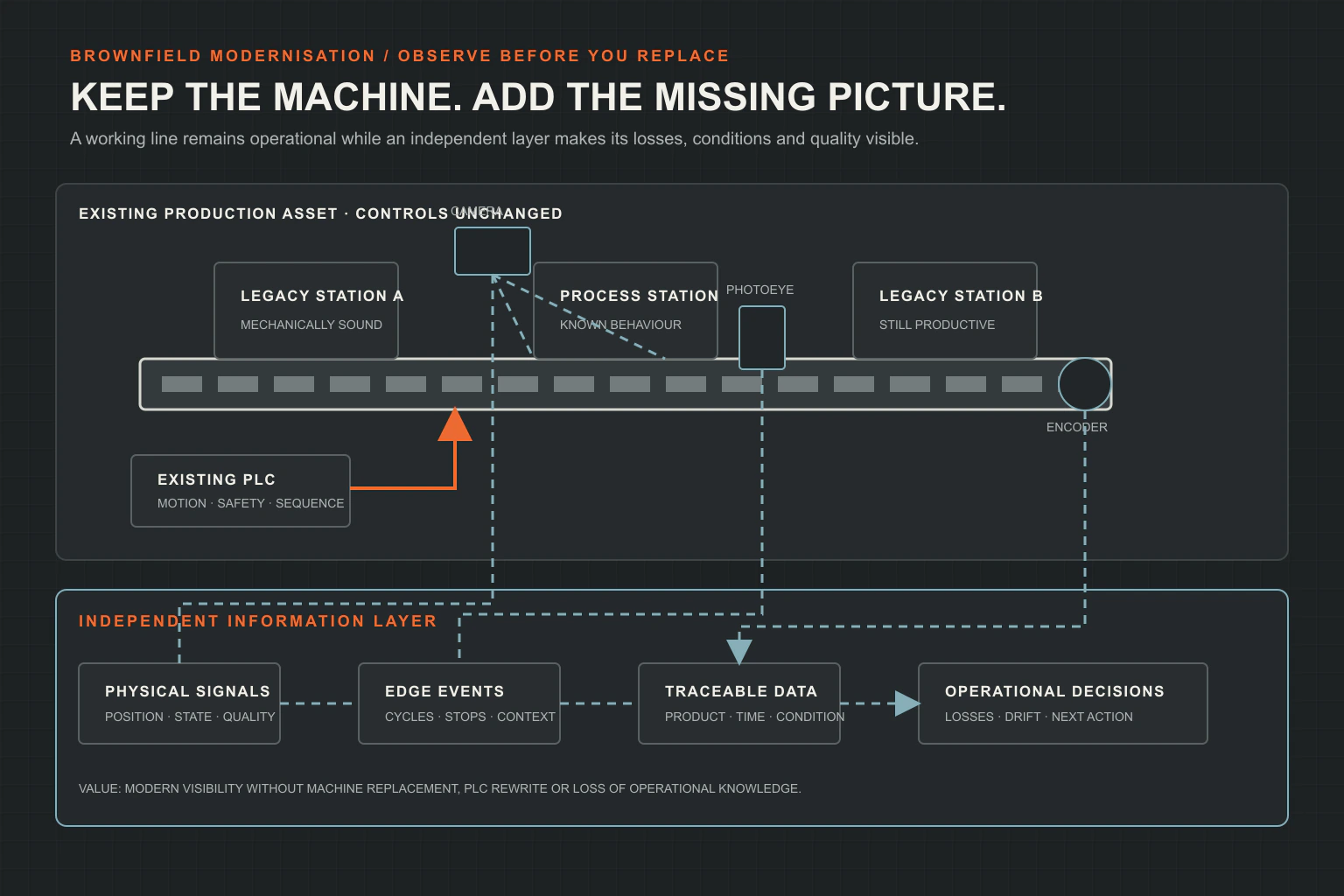
Most production lines do not need a dramatic transformation. They need a clearer picture of what is already happening — early enough for people to act.
Automation does not have to be painful
Working with real production lines leads to a simple but often overlooked conclusion: automation does not have to begin by replacing people, rebuilding equipment or rewriting PLC logic.
Most established lines already produce. Operators understand their behaviour, maintenance teams know their weaknesses and engineers have refined them over years. Radical intervention into that accumulated knowledge is expensive, risky and understandably resisted by production teams.
Yet the fact that a line runs does not mean the process is transparent. Quality can drift while every formal check remains acceptable. Output can fall without a reliable account of where the time went. A recurring failure may be discussed for months with no common evidence connecting material, machine state, operator action and final quality.
Human factor is not what we usually think
When a process fails, “human factor” becomes a convenient explanation. An operator missed a detail; somebody interpreted a measurement incorrectly; a decision came too late. That framing treats people as the defect.
In practice, human factor is more often a limitation of perception and decision-making under time pressure. Even experienced people work with incomplete measurements, uncertainty, tool orientation, delayed laboratory results and several competing signals. They must compress a complicated physical situation into a quick decision.
A value can remain inside its tolerance while moving steadily toward an unstable region. A defect may be small in total area but critical because of its location. Several individually acceptable parameters can combine into a poor functional result. None of these situations is solved by telling people to pay more attention.
Quality is contextual, not simply binary
Traditional quality control is built around discrete checks: measure a parameter, compare it with a limit and record pass or fail. That model is necessary, but it is not always sufficient.
The location of a deviation may matter more than its magnitude. Distribution may matter more than total quantity. Timing may explain what a final measurement cannot. The process conditions around an event can be more useful than the event on its own.
This is where a manufacturing information layer becomes valuable. It does not take authority away from the operator or the control system. It preserves the context that neither can hold alone: physical signals, movement, production events, images, quality results and time.
Modernise observation before control
ClariFab’s approach is to leave the existing machine controls responsible for running the equipment and add an independent layer responsible for observing it. Sensors, encoders and industrial cameras capture the physical process directly. Edge services convert observations into events. A separate information system combines those events with material, laboratory and quality data.
This architecture can provide objective cycles, downtime categories, condition trends, critical-operation inspection, fit-for-purpose OEE and traceability without requiring a modern PLC or support from the original machine builder.
Start with one missing decision
The right pilot is not “digitalise the factory.” It is one question the current process cannot answer reliably: Why did output fall during this shift? Which condition appears before a quality failure? Where does the real cycle expand? Which stoppages consume the most recoverable time?
Instrument that question, prove whether the evidence changes a decision, and only then extend the architecture. Automation earns its place by reducing uncertainty — not by increasing the amount of technology on the line.
Automation without pain begins with respect for what already works. Keep the useful machine, preserve the knowledge around it and make the missing parts of reality visible.